Pages

Showing posts with label puzzle. Show all posts

Sunday, 18 December 2011

An Interview with Stefano Gualeni


I recently tried out an iPad title called Gua-Le-Ni, which turned out to be a bizarre, but addictive and engaging puzzle game. I then got the opportunity to interview the game's creator, StefAno about Gua-Le-Ni's inspirations, his ideas behind it, and much more.
Q. So, Gua-Le-Ni is available to download onto the iPad now! How did you get the idea for this game?

A: Hi, an first of all thanks for the interest and the ‘love’ you are directing towards our bizarre project. It makes it feel that the long months of designing and crafting this book (or this game) were not completely futile, if we manage to stimulate the curiosity of some of you and to keep you intrigued in its concept and gameplay. As far as the idea for the game, it is more or less a mixture of childhood memories and my current philosophical focus.


My mother used to show me etchings of animals and bizarre creatures by either Albrech Durer or Leonardo Da Vinci as a kid, I was fascinated with those bizarre beasts and how they looked like monsters from other worlds. Building on that basis, the core idea for Gua-Le-Ni comes from the will to make of David Hume’s philosophy of mind playable. Essentially, my claim is that if a player learns how to play Gua-Le-Ni, then she also have absorbed most of the notions involved in Hume’s 1748 Enquiry Concerning Human Understanding. Some will also spot influences from ‘head-body-tail’ books such as the Animalario Universal del Professor Revillod:

Q. Were there any influences during it's creation?

A: Each an every member of our team contributed with some ideas or details, but I guess most of the design maintained a solid vision from start to end, so the influences mentioned in the previous question are still the leading ones. In the last months, some observations and ideas concerning embodiment in digital worlds and some inspiration to optimize the interfaces came from Helmut Plessner’s 1928 seminal book for philosophical anthropology “The Stages of the Organic and Man”.

I guess it’s more of a personal inspiration and aspiration rather than something overtly perceivable, but it helped, I am sure.

Q. As the games website states, "Gua-Le-Ni is the first commercially released video game whose development was guided by the analysis of it's players psychophysiological responses." What made you decide to do this whilst the game was in development, and and how do you feel it helped to shape the game?

A: More than feeling, I know it helped as I was also part of the research team behind the Biometric research. At NHTV University of Applied Science of Breda (The Netherlands) we relied on embodied psychology (biometrics or psycho-physiology), Which is to say the way that body signals can be interpreted as expressing internal states of a person. By observing the way stress and anxiety changed in our test subjects together with the changes in the game while designing and tuning it, we were capable – we believe – to have a better, more thorough and more objective insight in what it is like to play than it was ever possible to achieve with traditional quality assurance procedures. This experimental way to approach game design was never even attempted in the casual sector of the industry.

We utilized the equipment and experiments to determine the most desirable initial speed for the game and the optimal way the game should have grown in terms of speed and cognitive pressure in the non-fiction mode (the competitive one featuring a Tetris-like acceleration as cleverly pointed out in your review). We believe that the insights we obtained in that pioneering way objectively helped in determining a few key-variable in the tuning of the game.
Q. Do you think you'll be using this type of research again in your next projects?

A: If possible, I would love to. Together with the care and dedication of the programmers, the talent of the artists and the obsessive and continuous playtest sessions we have run, I believe it was a factor it the game’s success. Critical success I mean, whether its bizarre nature and explorative gameplay will be embraced by the public too, that’s still hard to tell. One can hope.

Q. Gua-Le-Ni has been receiving some generally excellent reviews so far. Did you expect to get this reaction?

A: Haha… Again, I was not expecting the interest and visibility the game is attracting but we – as any independent developer - hoped that the love we put it would be experienced and appreciated by other people. I believe that’s the reason why I am still making games. The hope to touch other people somehow…
Q. What I enjoyed the most about the game was the creation of some bizarre but interesting hybrid creatures, and the addictive nature of the gameplay. What is your favourite aspect of Gua-Le-Ni?

A: I am fond of the possibility to optimize one’s behaviour and compete. The game offers more secrets, more strategies and more opportunities for improvement than it might initially show. I am still playing the game months after intense playtest sessions precisely because of its depth and possibilities. Me and my testers are still trying to find out who’s the best… They brutally outperform me with the use of the dreaded black cube (one of those secrets), but I am still the best if we only consider the regular behaviour of the game (40.075 pages).

Q. And finally, what's next for yourself and for Double Jungle? 

A: My destiny and that of Double Jungle will remain woven at least until the end of February or March, when we will release a new version of the game including a completely new game mode. We are starting to work on the graphics and the voices in a few days. I believe this is not the last game we will do together, me and the guys of Double Jungle… We’ve been friends for years and find it nice and cozy to work with eachother. As a matter of fact we are also working on a social game that will run in web browsers that is also unique under quite a few aspects.

Next for me is finally concluding my doctoral dissertation… I hope that will be done by October 2012. And after that, who knows? Maybe another digital oddity with a philosophical theme? 

Saturday, 10 December 2011

Gua-Le-Ni Review

There are a number of games out there that fall into the oddity category, but Gua-Le-Ni, or The Horrendous Parade, created by Double Jungleis the first iPad title I have played that I could safely place under this category. Not that this is a bad thing though. In fact, the game is actually pretty good.


In Gua-Le-Ni, the player becomes a taxonomist, and is tasked with cataloguing fictional and real paper creatures. The game thrives on the introduction of a bizarre range of hybrids, which are actually quite a joy to piece together and discover. Anyone ever heard of a fish-rabbit? More oddities are welcomed into the game as the player progresses further in their scholarship. 


The aim of the game is to rotate the cubes (which represent a head and back end of a creature) at the bottom of the screen until they match the creature that is walking across the page. Depending on the difficulty and how much you have learnt, the game will either throw you two or four cubes to work with. A humorous and well-spoken narrator will guide you through the game, and offer some criticism if he thinks you are having too much of an easy time with it all too. 
Gua-Le-Ni has two modes to try out, a "Fiction" or "Non-Fiction." Both modes are pretty similar, but the Non-Fiction mode offers much faster moving creatures, and apples can be fed to the creatures in order to slow the procession down. The Non-Fiction mode encourages the players interaction with the scenery. For me, I found the Non-Fiction mode to be the best out of the two, as feeding the creatures allowed for a bigger score at the end than on the Fiction mode. In Gua-Le-Ni, there is only really one thing to do-match the cubes to create a whole host of constantly scrolling creatures. However, this seems completely irrelevant to challenge when you realise how addictive this cube switching experience actually is. 


The hand-drawn artwork included in Gua-Le-Ni is reminiscent to Terry Gilliam's rather trippy illustrations in Monty Python's Flying Circus. If you're familiar with this British comedy, you'll probably already have an idea of what the game is like: it's quirky, absurd, and pretty comedic at times. The beautiful looking style is one of the best parts of the game, and team this with some great classical music, and you're onto something pretty damn good.
The interesting thing about Gua-Le-Ni is the way it was play-tested during development. This iPad title is the first commercially-released casual game where development and tuning was guided by the analysis of it's players psychophysiological (or biometric) responses. Stress levels were monitored, so that unlike many constant scrolling, against the clock titles, this is actually much more of an enjoyable experience, than a stressful one. The game was inspired by the photographer David Hume and a Mexican book which allows for the recombination of animal parts.


The only thing that lets this game down slightly is that the rules and introduction are a little tricky to grasp at first. Once you actually get into the game though, the gameplay becomes second nature, and the aim is pretty simple to understand.


Gua-Le-Ni is a bizarre, but incredibly imaginative and addictive iPad title. The game's style is one of the most impressive aspects of this title, and it is something of a joy to see these weird and wonderful creations saunter across your screen. If you're looking for a puzzle game that successfully manages to break the mold whilst providing a Tetris style formula to the proceedings, then I would definitely recommend this game. Who would have thought that Taxonomy would be this much fun?
Check out Gua-Le-Ni's website here

Thursday, 24 November 2011

Retro Review: MediEvil

Originally released near Halloween in October 1998 (a rather fitting date for the games subject matter), MediEvil tells the tale of of a deceased knight (the noble Sir Dan) as he fights to rid the land of Gallowmere of the evil Zarok and his undead army. 


Sir Dan is definitely a hero gamers can root for. He's the underdog-the knight who dreamed of being regarded as a hero by his peers. Unfortunately though, Sir Dan fell in the line of duty at the beginning of the battle against the evil wizard Zarok. Thankfully, MediEvil allows Sir Dan to have another chance at gaining this renown, after Sir Dan is resurrected to battle Zarok, who has returned once again. As a player, you can definitely feel the excitement as you inch Sir Dan ever-closer to being regarded as a true hero. As a consequence, the storyline is one of the strongest parts of the game. 
To me, MediEvil is a cross between the gameplay of Ghosts 'N Goblins, and the gothic but fun aesthetics adopted in Tim Burton films, most notably The Nightmare Before Christmas. Being a huge fan of Tim Burton's work, I feel that this is why the game has stuck by me for so many years, and why I also have such fond memories of playing through it. 


The game involves collecting and using a variety of weapons to hack through a hoard of creatures. Although hacking and slashing makes up a large amount of the game, MediEvil is punctuated with puzzle sections, each unique to the last. It makes for a nice change, and stops the game from becoming too repetitive and as a consequence, boring. There is also a chance to upgrade weapons by visiting gargoyles or opening treasure chests, and collecting items throughout the levels. Once a certain number of enemies are obliterated, a chalice can be gained which gives you access to the Hall of Heroes, a place where heroic ghosts give Sir Dan special weapons or items on each visit, which is a nice incentive to keep playing. 
Unfortunately every game, even the supposed "perfect" ones, suffer from a flaw or two, no matter how great or small it may be. In MediEvil, it is firstly, the camera positioning. This is a common problem in this genre, and in this game, the perspective has to be shifted regularly in order to get a better view of the surroundings. Secondly, some may find the idea of repeatedly hacking and slashing through levels little tiresome, but if you're after a light-hearted, no-brainer hack and slash game, then look no further than MediEvil


On face value, MediEvil lacks innovation, as it adopts the straight forward hack and slash platformer that we have seen many times before. However, the puzzles are a joy to complete, and the cartoon-gothic style is a pleasure to look at. MediEvil triumphs the most in it's goofy, humorous and engaging story and great, spooky looking visuals. The mix of unique levels and puzzles also add a substantial amount of diversity to the proceedings. The game is let down somewhat by the frustrating camera controls, but on the whole, this platformer is great fun. 

Monday, 29 August 2011

Zoo Keeper DX Touch Edition Review

Often a game comes along that leaves players itching to have "just one more go." This often results in subsequent tries after the first, until a good amount of time has passed. This is often a sign of a great game. Zookeeper DX Touch Edition is one of those games.

Originally released as an online puzzle game, Zoo Keeper was then ported onto the Nintendo DS in 2004. A Playstation edition shortly followed, and then everything was quiet on this games front. Fast forward seven years and Zoo Keeper was revived once again for the iPod, and entitled Zookeeper DX Touch Edition.
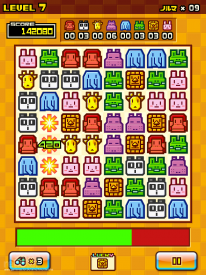
Fans of the original version will notice that the game play is the same here. The game play simply involves matching three of the same animals or more in lines in order to progress to the next level. As simple as this sounds, the difficulty (as expected from games like this) gets increasingly hard, until the point where panic sets in. Fail and it's right back to level one again. As disheartening as that may sound, it really isn't too much of a hardship. The addictive nature of the game play makes you want to keep attempting to beat your previous high score. 

The matching into sets of three of more element has been tried and tested many times before (think Bejeweled for instance), but the cutesy animal graphics definitely set this apart. 
Players have a choice of two modes, Normal, where you keep playing until the time runs out, and Tokoton, in which the player must catch 100 types of animals in order to progress to the next level. What is missing from the original is the Quest mode, which allowed players to complete a variety of challenges in order to move up the levels. This mode was one of the most enjoyable aspects of the original, so it seemed a shame that it was not included on the iPod edition. 

Upon it's release, Zookeeper DX Touch Edition suffered from a number of bugs, including the occasional freezing screen and ratio problems. However, it appears that these problems have been ironed out now, and thankfully I have not encountered any more. I was somewhat disappointed that the leader-boards do not have the achievers name next to it. As someone who shares an iPod with another, it is hard to remember who scored what when there is no option to input a name next to a high score.
In conclusion, Zookeeper DX Touch Edition is a highly addictive puzzle game for the iPod. Whilst it may lack the Quest mode of the original game, the game play on offer is very accurate to the previous version, so fans should enjoy this. The cute graphics heighten the game's appeal, and add to the overall enjoyment. Whilst the game gets incredibly hard as the levels progress, it does sour the games experience. In fact, the challenge is welcoming, and helps to keep people coming back once again to attempt to beat their personal high score. At only 69p in the App store, this is quite a bargain when you realise you've pumped a considerable amount of hours into it. Just warning you one last time though, it IS addictive. 

Wednesday, 20 July 2011

Preview: Wyv and Keep


Today I got the opportunity to play a preview version of upcoming puzzle-platformer, Wyv and Keep. Created by indie games company A Jolly Corpse, this grid-based adventure follows two treasure hunters, Wyv and his female companion, Keep. Wyv and Keep must make it through a series of deadly traps and stubborn obstacles to make it to the exit of each level. Wyv and Keep must work together to make it to the end of the level, and this can be achieved in single-player mode (the shift key worked as a character switcher) or in multiplayer mode, where both players take control of one character each. 

Thursday, 14 July 2011

ilomilo: A Heart-warming Puzzle Game.

Every once in a while a game comes along that leaves a smile on your face. For me, Pikmin was holds aspects of this, but now an Xbox Arcade title has grabbed the first place for adorableness. 


ilomilo was released in November 2010 on the Xbox Live Arcade. Available as a downloadable title, ilomilo features a simple premise: reunite Ilo and Milo so that they can go for a picnic together. Being a puzzle game, reuniting these two companions is not going to be a particularly easy task. Obstacles will be in their way, strategies will have to be implemented, and both characters will need to work together (either by a single player pressing a button on the controller to switch character, or with another player) in order to reunite to complete the level. The game features 49 levels which steadily get much trickier as the game progresses. 
In order to meet up with one another, Ilo and Milo must walk across stretching, expanding dogs, ride an assortment of creatures, drop through trapdoors, bounce across gaps or create bridges to maneuver them. Ilo or Milo cannot jump away from obstacles, or to a higher level. Instead, the puzzle part comes in to how to steer a path through the obstructions. Players will have to put their thinking caps on to work out how to move cubes into the rightful place, avoid obstructing creatures, and free themselves from dead ends. The puzzles can be very frustrating at times, especially towards the final level, but they are achievable after a long bout of trial and error. It all depends on how great your level of persistence is though. 


Playing this with another person is definitely the most enjoyable way to experience ilomilo. Whilst players have to take it in turn to navigate their character through the level, the other player gets to mess around with some quirky little characters playing out of tune instruments. Whilst this is only a simple touch, like everything in this game, simplicity definitely wins. 
The heart-warming element of ilomilo comes in the game's design. The world appears to have been created out of patchwork material, and each character (including Ilo and Milo themselves) seems to be made out of the same substance. There is a child-like quality to the surroundings, and this is made more apparent in the smaller details, such as drawn on crayon faces on the trapdoors, and the look of the creatures. The backgrounds are just as vibrant, detailed and cute as the foreground, and the cheerful music further adds to this already cute, quirky, and happy game. 


The premise is incredibly simple here, but the message on offer carries enough emotion to create a thoughtful, evoking game. The simple tale of friendship is something that surely everyone can relate to. Both characters work together in order to complete the level, and this makes ilomilo an excellent two-player game. 
Those who own Raskulls, or A World of Keflings should be aware that purchasing ilomilo unlocks some additional content in both of these games. A World of Keflings additional content allows you to incorporate Ilo and Milo into the game (complete with their own house) whilst Raskulls allows players to race as these cute characters.


There is plenty to love in ilomilo. The puzzles are thoughtfully constructed, the innocent, child-like setting adds to the heart-warming feeling, and the simple music, cute characters and adorable premise means that it is hard to not have a smile on your face whilst playing this. The presentation is where ilomilo appears to succeed the most though, as the levels and cute look are well thought out. The quirkiness may not appeal to everybody, but for those prepared to accept this, deep within an enjoyable game is found. 

Monday, 20 June 2011

Patrick Stewart to narrate War of the Worlds game

HG Well's classic novel The War of the Worlds has already spawned many successful projects, such as most notably, composer Jeff Wayne's musical masterpiece by the same name, or the 1953 and 2005 film versions. 

There are plenty of games out there involving alien invasions for you to experience, but there have not been any hugely successful video game adaptations. Finally, it appears that one is currently in the works, as the early art and screen-shots look promising. I have always felt that War of the World's would translate well as a video game, as navigating a character across an invaded and destroyed London whilst Tripod's are firing their heat ray around you should only further enhance the horror that is conveyed through reading the book. Hopefully this time it has been truly perfected.

Narrated by Sir Patrick Stewart, star of Star Trek and X-Men among many others. The game will be told in a series of flashbacks, with the narrator (Stewart) relaying what happened during the martian invasion. War of the Worlds will be a 2D side scrolling puzzle-adventure game, and the Prince of Persia series was a significant influence in the making of this game, so those who have played any of the Prince of Persia games should already have an idea of what to expect in terms of the game play on offer here. 

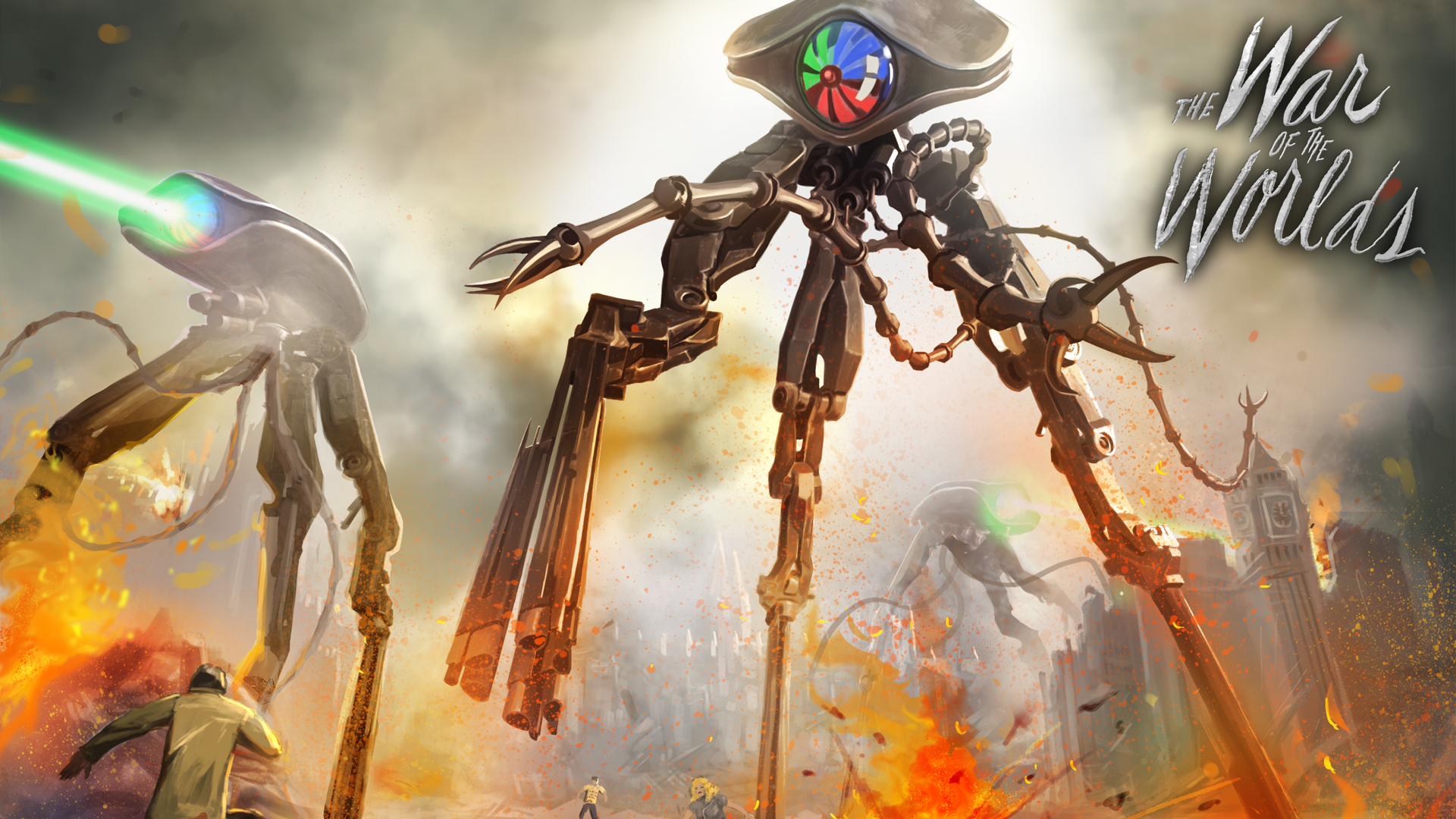
The game will be set during the alien invasion, where the iconic tripod aliens have already devastated most of 1953 London. The original novel was set during 1898 London, but I believe the developers must have preferred to depict 1950s London than the London in the novel. However, if these screen-shots and official art are going to be just like the final product, it appears that the developers have successfully captured the terror and sheer apocalyptic feel that HG Wells successfully manages to convey in his classic novel. The developers have promised that this will be a game to test players nerves. Thinking fast and making good decisions during your journey across the debris of London will keep you alive. Mess up and progress too slowly and unfortunately your character may end up in the Martian's clutches. 

This game looks like it is going to be a vibrant one, as the early screen-shots show that the Martians and the fire are bright greens and reds. After watching an interview with one of the creators (see below), I was right in assuming that these bright colours are put in place to further convey the danger and terror of the giant Martian-powered Tripod's. This creator explained that the bright colours of the enemies are also put in place to clearly show players where the danger lies on the screen. So simply put, it appears that this video game will be somewhat colour coded.


War of the Worlds will be released as an Xbox Arcade title, which will be available to purchase and download on the Xbox Live Marketplace, and the Playstation Network.The price is still unannounced for now, but War of the Worlds will be released by the end of 2011. I will be sure to post an update once any more news, and hopefully soon a trailer, arises. 
Do you have high hopes for War of the Worlds? Comment with your opinions!
Related Posts Plugin for WordPress, Blogger...